Puzzle Parking or Car Stackers
Puzzle parking or car stackers: both add capacity inside a footprint that already exists. They differ in how a driver retrieves a vehicle, and that difference drives the capital cost, the clearance requirement and the operating model the building has to run.
Two systems dominate high-density parking on constrained sites: mechanical car stackers and semi-automated puzzle parking. This guide sets out where each one fits.
The deciding question
Who parks the car.
Car stackers suit sites with an attendant or valet, or where an assigned user accepts moving one vehicle to reach another. Puzzle parking suits sites where drivers park themselves and expect direct access to their own space at any hour. Cost, height and capacity follow from that answer.
What a car stacker does
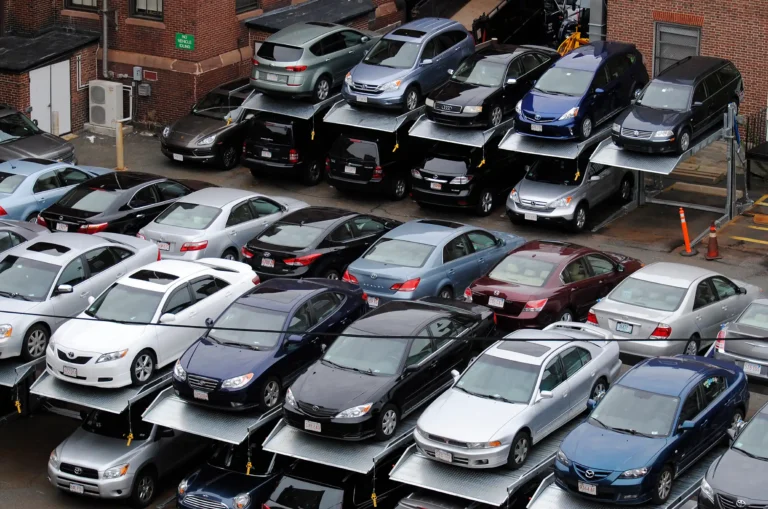
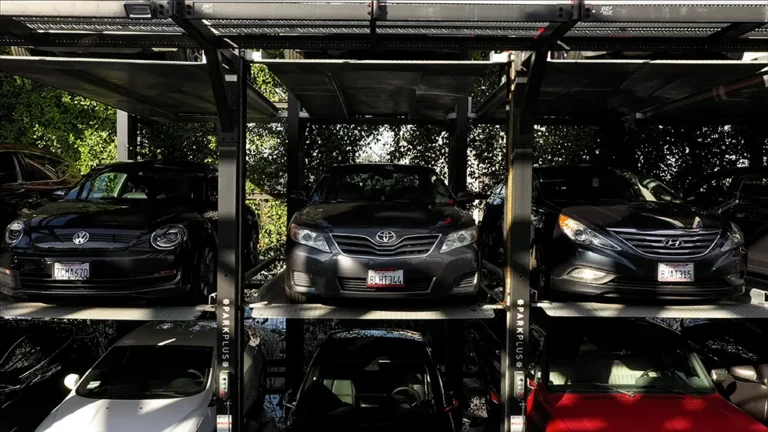
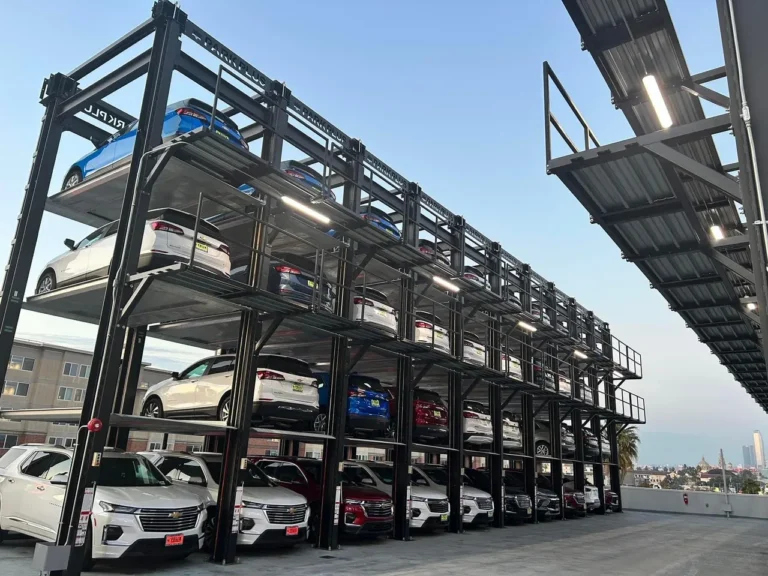
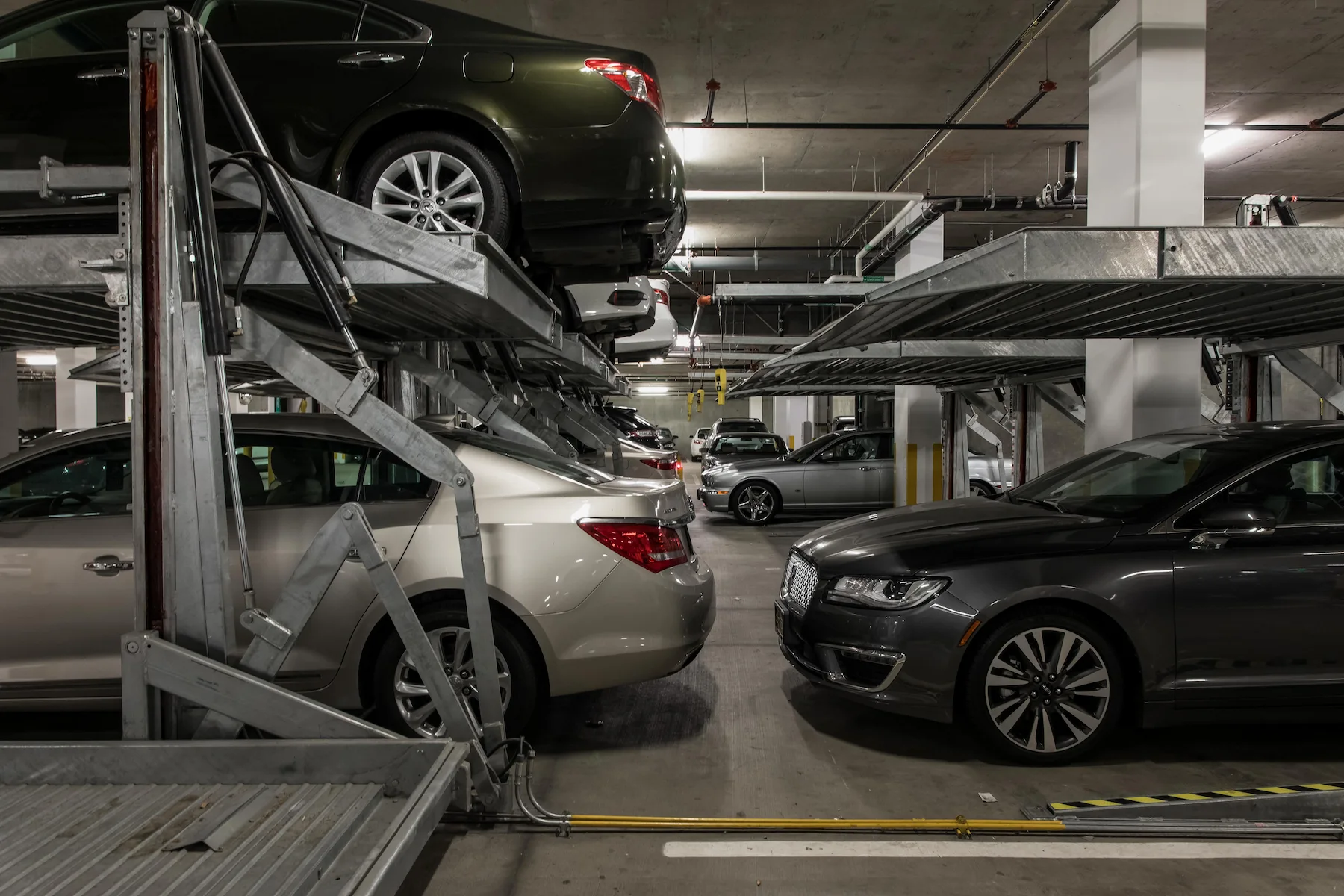
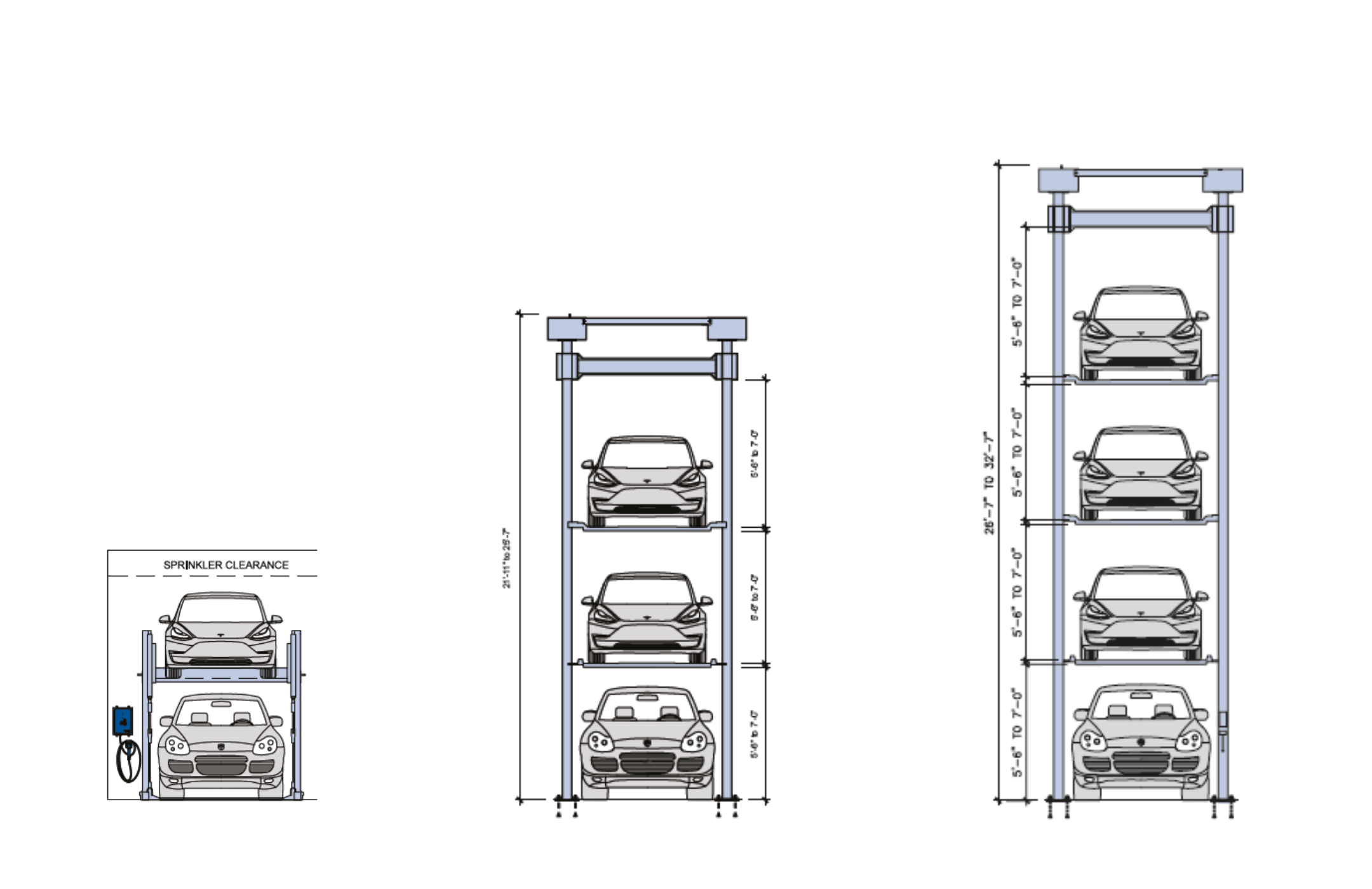
A car stacker raises a vehicle on a platform so a second vehicle can park beneath it. Triple and quad configurations nest further platforms above, to a practical maximum of four levels. Actuation is hydraulic or electromechanical, and both are mature technologies.
Most stackers in the US market are dependent, meaning the lower vehicle moves before the upper vehicle can come down. That is why the category is priced where it is. Fewer moving parts, a simpler structure, no shuffling logic to manage.
Total ceiling clearance runs 11 to 15 feet depending on the vehicle mix and the number of levels. Load transfers through the columns to the slab or the building frame, which concentrates that load at fewer anchor points than a continuous deck.
The mechanical category is covered in full in the ParkPlus guide to parking lifts in America.
What a puzzle parking system does
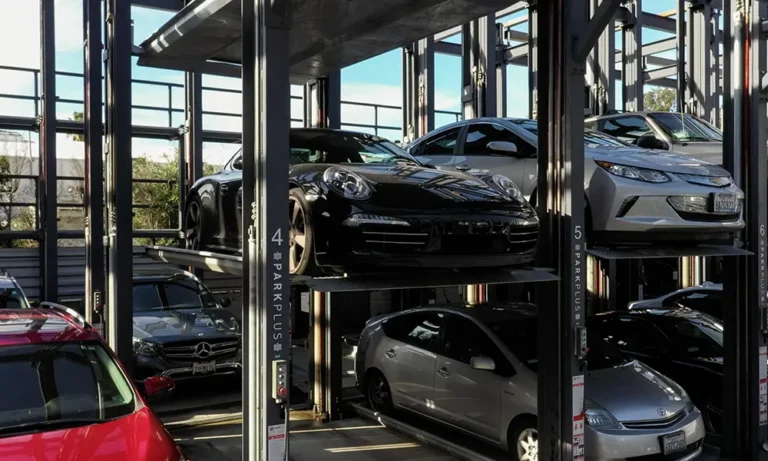
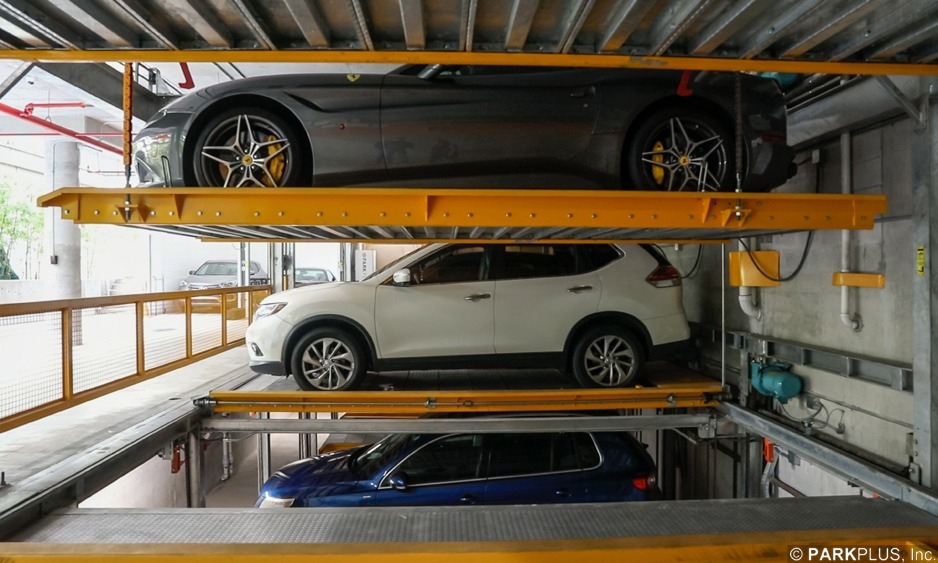
A puzzle parking system arranges platforms in a grid that moves vertically and horizontally. ParkPlus builds it as the Lift-Slide system. A programmable logic controller runs the grid, and the driver triggers a cycle from a keypad, fob or remote.
The grid holds one empty position, and every retrieval works by moving that empty position to where it is needed. No attendant is involved at any point in the cycle.
Configurations run indoors or outdoors and accept a roof, side screening and controlled doors. Where excavation is viable, a pit level adds capacity below grade rather than above it.
Side by side
| Car stackers | Puzzle parking | |
|---|---|---|
| Category | Mechanical | Semi-automated |
| Operated by | Valet, attendant or assigned driver | The driver, unattended |
| Access | Usually dependent | Direct access to every space from grade |
| Levels | Two to four | Multiple levels, plus optional pit |
| Retrieval | Immediate when the path is clear | Short cycle while the grid shuffles |
| Density gain | Two to four times | Scales with grid size |
| Relative capital cost | Lower | Higher |
| Suited to | Long dwell or managed turnover | Daily in and out |
| Controls | Key switch to card reader | PLC with keypad, fob or remote |
Every ParkPlus system is engineered to the site, so figures above describe the categories rather than a specific configuration.
Four factors that decide the specification
Operating model
A dealership, a valet-served hotel, a collector storage facility or an attended urban garage has trained staff running cycles. A dependent stacker delivers the same space count at lower cost in each case. A multifamily building has no one available to move a vehicle at midnight.
Dwell time
Long-dwell vehicles tolerate dependent access. Collector vehicles sit for months and retrieval is scheduled in advance. Commuter vehicles move twice a day on a schedule the building does not control, and each dependent retrieval becomes a coordination task for the operator.
Building envelope
Stackers require clear height and a slab or frame engineered for concentrated loads at the anchor points. Puzzle systems require comparable height plus horizontal room for the grid to travel, and gain capacity from a pit where the site allows excavation. Both cases belong in the structural conversation at the first sketch rather than at permitting.
Capital position
A stacker costs less per space installed. A puzzle system costs more and delivers unattended direct access, which in residential product is often what separates a parking count that satisfies zoning from a parking count residents will accept. Both are measured against the alternative: structured parking in the US averages around $52,000 per space above grade and $73,000 below.
Where each system is deployed
Car stackers are standard in dealership inventory and display, valet operations at hotels and offices, attended urban garages, collector storage, and residential buildings with managed parking. ParkPlus builds them as the DP003 double stacker, TP500 triple stacker and QP1000 quad stacker, with the SP100 suspended platform for irregular geometries and drive aisles.
Puzzle parking is deployed in multifamily residential, mixed-use and luxury condominium projects, where assigned self-park is expected and no attendant sits in the operating model.
Mixed-use projects frequently run both, with puzzle parking serving residents and stackers serving the valet or commercial portion of the same structure.
Before specifying either system
Bring the parking count, the vehicle mix and the operating model to the same conversation. Vehicle mix carries more weight than most specifications allow for. Platform capacities and dimensional envelopes are hard limits, and the US fleet has grown heavier and taller across the last decade, so a system sized for the current mix can fall short of the mix in service 10 years from now.
Both categories are mechanical assets in daily operation. Preventive maintenance is typically quarterly inspection with annual service, across a service life of 15 to 25 years. Parts availability and service network coverage carry as much weight as the purchase decision, particularly outside major metropolitan areas.
ParkPlus has designed, manufactured, installed and supported high-density parking since 1969, across more than 1,500 completed projects. Contact us to review your site plans and parking count.
Frequently asked questions
Is puzzle parking the same as a car stacker?
No. A car stacker is a mechanical lift moving vertically, usually dependent and usually attended. A puzzle parking system moves platforms vertically and horizontally under programmable control, giving every space direct access from grade without an attendant.
Can puzzle parking operate without an attendant?
Yes. Unattended self-park is the basis of the category. Drivers trigger a cycle from a keypad, fob or remote, and the system delivers the requested vehicle to grade level.
How many vehicles fit in a puzzle parking system?
Capacity scales with the grid rather than a fixed multiple, and depends on the number of columns, the number of levels and whether a pit level is included. Every system is engineered to the available footprint and clearance.
Which costs less, car stackers or puzzle parking?
Car stackers cost less per space installed. Puzzle parking costs more and delivers unattended direct access, which is the requirement in most residential projects. Both are measured against the cost of the alternative, with structured parking in the US averaging around $52,000 per space above grade and $73,000 below.
Do both systems support EV charging?
Yes, at grade and at elevated positions, specified at design stage rather than added later. Charging load is a building electrical design question as much as a parking one.
What ceiling height does each system need?
Car stackers typically require 11 to 15 feet of total clearance depending on the vehicle mix and the number of levels. Puzzle systems require comparable height for the equivalent number of levels, plus horizontal room for the grid to travel. Both figures are site-specific and confirmed during design.