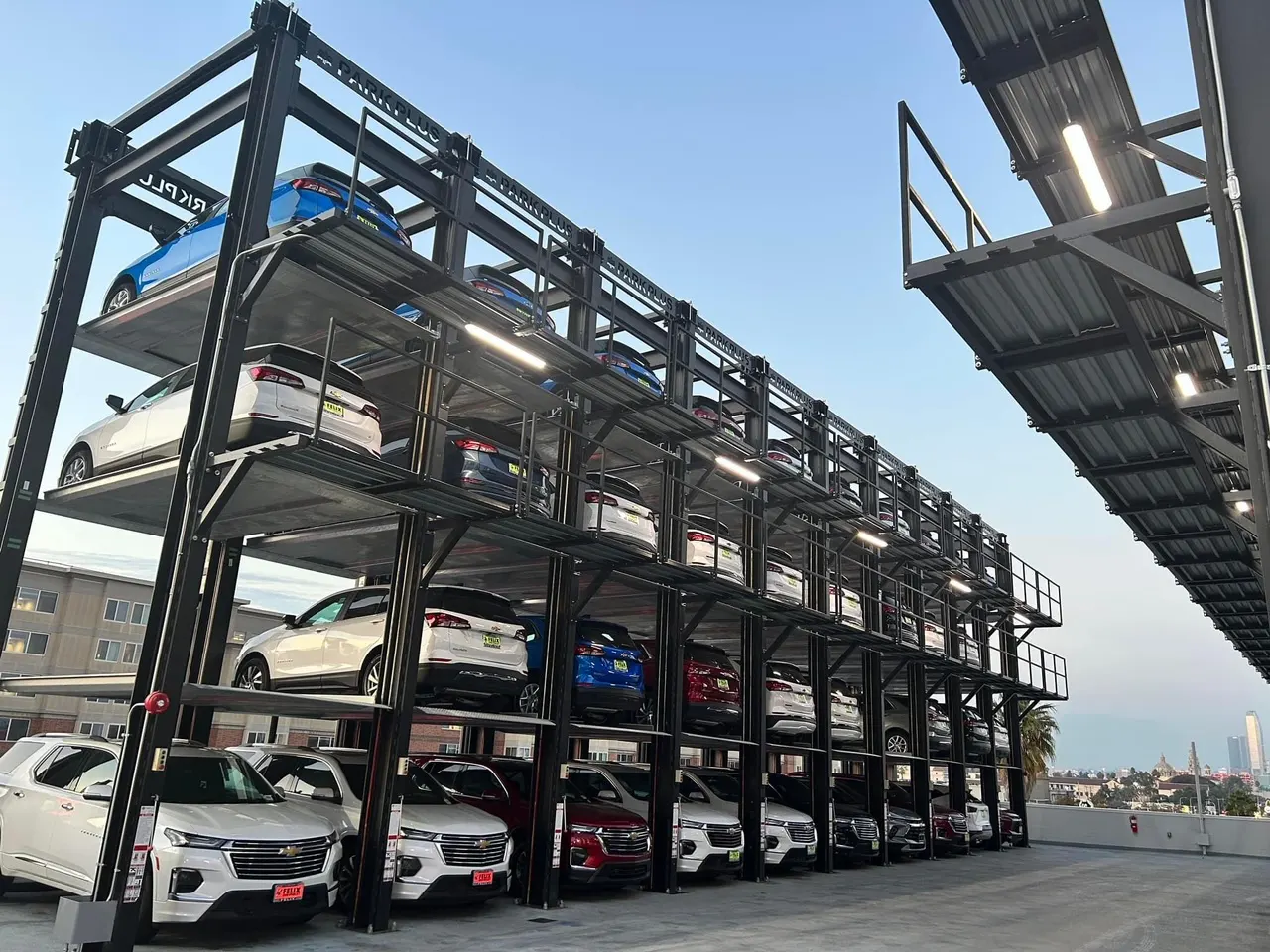
Stack Smarter: How Double, Triple & Quad Stackers Are Transforming Dealership Operations
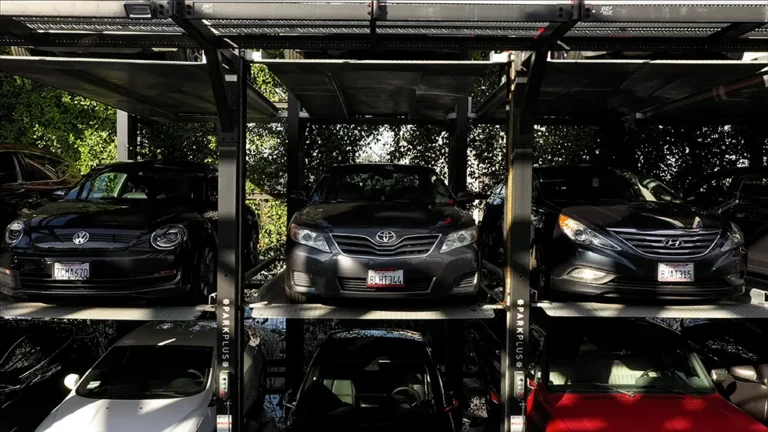
Modern dealerships are under pressure with inventory swings, limited land, rising real estate costs, and the need for efficient service operations. Multi-level mechanical stackers or parking lifts, like Double, Triple, and Quad Stackers, are now a core strategy for dealership expansion and modernization.
Here’s why more dealerships are making the shift:
- Instant inventory expansion without acquiring new property
- Faster service throughput by freeing drive aisles and staging areas
- Improved display visibility for rooftops, lot perimeters, and premium models
- Lower operating overhead by consolidating vehicles on-site
How Multi-Level Systems Improve Dealership Performance
1. Inventory Efficiency: More Cars per Square Foot
Traditional dealership parking uses ~300 square feet per vehicle (stall + circulation).
Multi-level mechanical systems reduce this dramatically because:
- Platforms share a common structural frame
- No ramps
- No circulation lanes between levels
- Vehicles are “stacked” within the same footprint
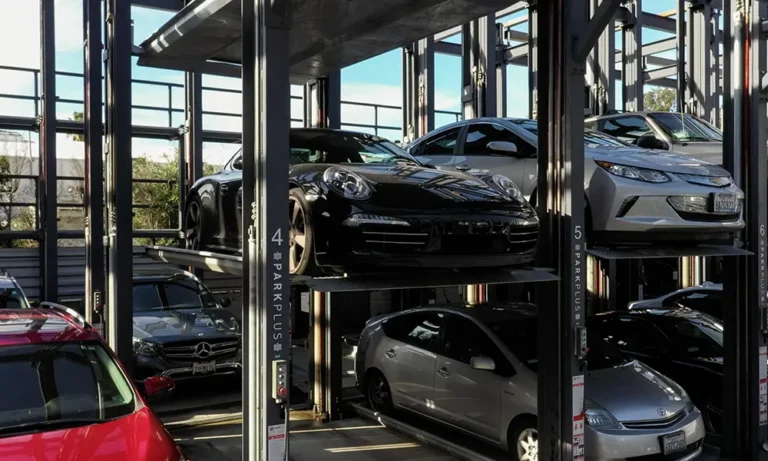
By storing 2, 3, or 4 cars vertically, dealerships compress inventory into half or a quarter of the surface area.
| System Type | Cars per Footprint | Typical Vehicle Sq Ft | Efficiency Gain |
| Surface Lot | 1 | ~300 sq ft | Baseline |
| DP003 Double | 2 | ~150 sq ft each | ~50% land savings |
| TP500 Triple | 3 | ~100 sq ft each | ~66% land savings |
| QP1000 Quad | 4 | ~75 sq ft each | ~75% land savings |
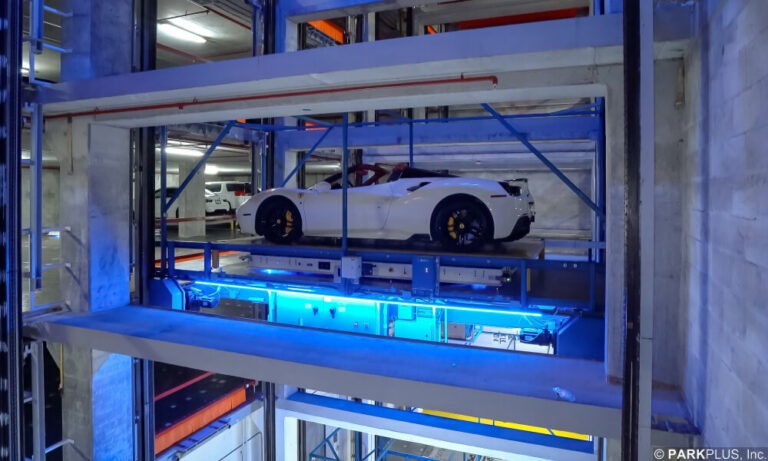
For example, optimized automated systems can reduce the footprint to 160–180 sq ft per vehicle, achieving 60–80% space savings compared to conventional layouts. While stackers are mechanical (not automated), the spatial logic is the same: stacking vertically dramatically reduces land requirements.
2. Service Bay Throughput: Clearing Ground-Level Congestion
Service departments lose time navigating around parked vehicles. Stackers:
- Open up drive aisles by moving stored vehicles vertically
- Increase staging areas for rapid intake/drop-off
- Allow service teams to pre-position vehicles in stacker arrays
- Prevent “vehicle sprawl,” reducing time spent locating cars
This leads to smoother workflows and more revenue-producing service time.
3. Better Display Visibility & Sales Impact
Many dealerships now use stackers for:
- Rooftop vehicle towers
- Perimeter branding displays
- Showcasing high-value models above ground level
4. Lower Operating Costs
Mechanical stackers reduce costs by:
- Minimizing off-site storage leases
- Reducing towing/shuttling between lots
- Limiting vehicle damage (hail, vandalism, tight-maneuver incidents)
- Lowering lighting and HVAC needs compared to multilevel garages
For many modern dealerships, stackers are the tool that keeps inventory manageable, service efficient, and land costs under control.
| Model | DP003 Double Stacker | TP500 Triple Stacker | QP1000 Quad Stacker |
| System Type | 2-post, 2-level cantilevered lift | 4-post, 3-level lift | 4-post, 4-level lift |
| Vehicles Stored per Footprint | 2 | 3 | 4 |
| Load Capacity (per platform) | 6,000 lbs | 6,000 lbs | 6,000 lbs |
| Typical Height Range | Adjustable; dependent on vehicle clearance | ~21′-11″ to 25′-7″ | ~26-7″ to 32′-7″ |
| Platform Type | Galvanized cantilevered | Galvanized nesting platforms | Galvanized nesting platforms |
| Installation | Indoor/outdoor | Indoor/outdoor (engineered foundation) | Indoor/outdoor (engineered foundation) |
| Vehicle Types Supported | Compact, sedan, SUV | Compact, sedan, SUV (custom for vans/boats) | Compact, sedan, SUV (custom for vans/boats) |
| Best For | Service lanes, quick-turnover inventory, small lots | Rooftops, inventory expansion, high-volume dealerships | Maximum-density rooftop storage, tight parcels |
| Primary Dealership Impact | Instant 2x capacity | 3x capacity in same footprint | 4x capacity for constrained sites |
| Operational Benefit | Frees ground space for staging & service flow | Ideal for rooftop yards & high-volume inventory | Turns rooftops/edges into high-capacity storage zones |
Where These Systems Fit in Dealership Planning
Multi-level stackers make the biggest difference on dealerships where space is limited or land costs are high. Urban sites can expand inventory without acquiring new parcels, rooftops can be converted into productive storage, and auto groups can consolidate multiple overflow lots into one efficient location.
Service-focused dealerships also benefit by moving vehicles vertically, they free up ground-level space for staging, intake, and customer flow. Stackers even serve as effective temporary storage during construction or renovation phases.
These systems are versatile in placement: beside service departments, along perimeter lot edges, on rooftops (where Triple and Quad Stackers excel), or in off-site yards that need to triple or quadruple capacity.
ParkPlus systems are well-suited for dealership environments: they are engineered for indoor and outdoor use, carry approvals in major U.S. cities such as New York, Los Angeles, Miami, and Boston, and offer commercial-grade strength, seismic compliance, and adjustable sizing options.
This combination of high-density performance, urban compatibility, and proven durability is the reason ParkPlus is widely chosen as dealerships make smarter, more efficient use of their sites.
Featured Projects

A dealership in Chantilly, VA features an outdoor ParkPlus QP1000 Quad Stacker to showcase vehicles.

In Baltimore, a dealership is equipped with 14 ParkPlus QP1000 Quad Stackers.

In Long Island City, NY a dealership is equipped with 34 Custom oversized ParkPlus QP1000 Quad Stackers with roof, gutters and leaders.

A dealership and service center in San Francisco Auto is equipped with 44 ParkPlus DP003 Double Stackers for increased service and inventory capacity.

In Downtown Montreal, a dealership features a 136-space indoor ParkPlus QP1000 Quad Stacker system — the largest indoor Quad installation in North America.
Need more information for your dealership?
Visit the ParkPlus Auto Dealership Solutions page